
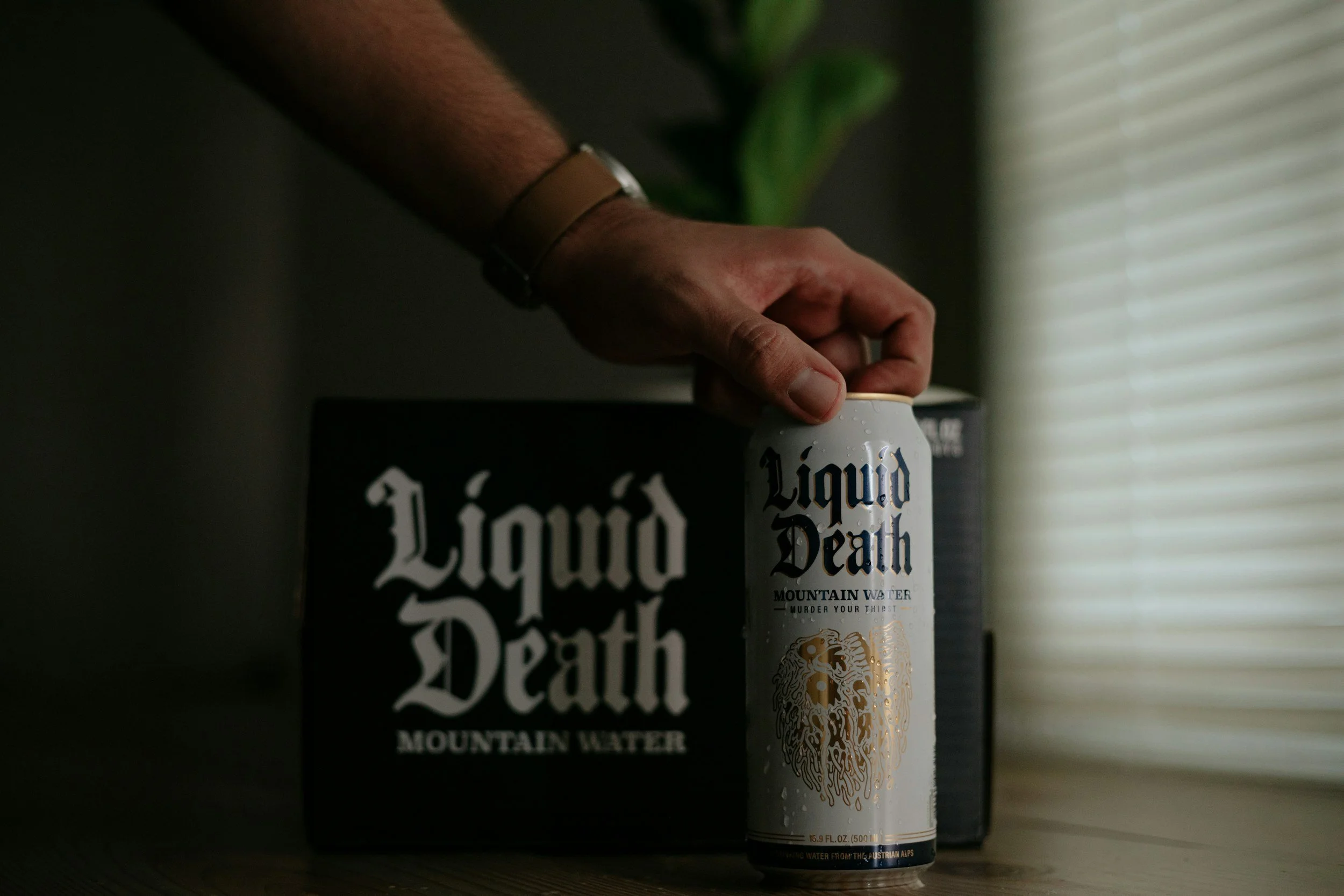
Delicious, refreshing, classic Liquid Death.
For years, Liquid Death was one of the most culturally magnetic beverage brands on shelves. The brand built loyalty through irreverent marketing, distinctive packaging, and a simple product promise.
But when Liquid Death changed its formula, the response was immediate and vocal.
I myself was a fan of Liquid Death before the change, and most of my IRL friends have already heard this rant-turned-case-study many times before. This isn’t just a story about taste preferences. It’s a case study in what happens when a culture-first CPG brand changes the product experience without fully preparing its community.
How Liquid Death became a cult brand.
Liquid Death entered a category that was, frankly, boring. Bottled water brands leaned into minimalism, purity language, and soft blue branding. Sparkling water brands held hands over their mediocre products and whispered flavors.
Liquid Death did the opposite.
Instead of plastic bottles, we got aluminum tallboys. Instead of wellness clichés, we got sick artwork and tongue-in-cheek aggression. They made a death metal compilation of hate comments. And they actually delivered on flavor.
That differentiation worked.
By 2024, the brand had reached an estimated $1.4 billion valuation and generated hundreds of millions in annual retail sales. That level of growth in a commoditized category like water is rare. It happened because Liquid Death wasn’t competing on hydration alone—it was competing on culture.
Customers felt like insiders. Buying the product was participation in a joke the mainstream didn’t fully get.
That kind of loyalty is powerful.
It’s also fragile.
The Liquid Death formula change.
The core of the controversy centers around sweetener reformulation. Originally, many of Liquid Death’s flavored sparkling waters and teas used agave as the sweetening agent. It was delicious and sweet without being overpowering or heavy like a soda might be.
And then they switched to Stevia.
From a product development perspective, this isn’t shocking. Stevia offers zero calories, aligns with lower-sugar trends, and supports “better-for-you” positioning in a competitive beverage market. On paper, it likely improves nutrition labels.
But taste perception doesn’t happen on paper.
Stevia is notoriously polarizing. I’m not the only one who thinks it has a horrible aftertaste. So for me and everyone else who hates Stevia… we stopped buying.
The Reddit backlash and community sentiment.
For better or worse, consumer backlash today unfolds in real time across Reddit, Instagram, and product reviews.
In multiple Reddit threads discussing Liquid Death’s stevia reformulation, customers described canceling subscriptions, returning products, or abandoning the brand entirely.
What’s critical here is not whether every customer disliked the change. It’s that highly engaged customers felt alienated, no longer able to enjoy a product that had become a staple for them.
For culture-forward brands, these are not fringe voices. These are core community members. When backlash surfaces among loyalists rather than casual buyers, it signals a deeper issue: the emotional contract has been disrupted.

Why this is more than a taste issue.
At face value, this could be dismissed as simple preference. Some people like stevia. Some don’t.
But Liquid Death built more than a beverage portfolio. It built a brand personality that positioned itself as anti-corporate, transparent, and community-driven. When that kind of brand makes a product change without visible dialogue, it creates cognitive dissonance.
Consumers begin asking:
Was this a cost decision?
Was this a margin play?
Was this trend-chasing?
Even if the decision was rooted in health optimization or supply chain strategy, silence invites speculation.
Brand loyalty is sustained by perceived alignment. Once consumers feel misaligned, retention risk increases dramatically.
The “New Coke” parallel.
The comparison insists on itself.
The Coca-Cola Company made a now-infamous decision in 1985 to reformulate Coca-Cola. Blind taste tests suggested consumers preferred the new flavor. On paper, it made sense. On the market, consumers revolted.
Why? Because Coca-Cola buyers are notoriously loyal. “Is Pepsi okay?” might as well be fighting words for these people. Reformulating Coke was like changing something holy, something sacred. And, well, the rest is history.
Liquid Death’s situation is smaller in scale but similar in psychology. When a brand’s appeal is deeply emotional, product adjustments carry amplified consequences.
Consumers don’t resist change because they hate innovation. They resist change when they feel excluded from it.
The business risk of beverage reformulation.
Reformulating a product in a saturated CPG market introduces several risks that go beyond flavor profile.
Customer retention and LTV
Subscription models and repeat purchases rely on consistency. When the sensory experience changes, habitual buying patterns can fracture. Even a small churn percentage increase can materially impact lifetime value projections.
Brand equity erosion
Liquid Death’s brand equity is built on differentiation. If customers begin associating the product with unpleasant aftertaste or inconsistent flavor, that differentiation shifts from positive to negative.
Negative word-of-mouth amplification
Virality built Liquid Death’s rise. Negative virality travels just as quickly. In the digital era, dissatisfaction scales. When Reddit threads rank in search results for “Liquid Death formula change,” perception is shaped long before first purchase.
What Liquid Death could have done differently?
Here’s my hot take: They shouldn’t have changed the formula at all.
Liquid Death wasn’t a struggling brand in need of reinvention. It was actively taking over shelf space in major grocery chains. Tallboys were multiplying. Multipacks were expanding. The brand was moving from novelty to staple.
When a product is winning—visibly winning—reformulation introduces unnecessary risk.
From a strategic standpoint, you change formulas when:
The product is underperforming
Consumer demand clearly shifts
Regulatory pressure forces it
Or the cost structure becomes unsustainable
Liquid Death didn’t appear to be in that position. It had velocity. It had cultural dominance. It had differentiation.
And most importantly, it had taste loyalty.
The beverage aisle is brutally competitive. Consumers rotate through options constantly. When a brand earns habitual purchasing behavior, that is gold. Altering the sensory experience of a habit product is one of the highest-risk moves a CPG company can make.
There’s also the shelf reality.
Where Liquid Death once felt omnipresent—stacked aggressively, moving quickly—the shift is noticeable. Multipacks linger longer. Displays feel less urgent. The “must-grab” energy is muted. Is that entirely due to the stevia shift? Impossible to prove without internal sales data.
But perception matters. If previously devoted customers (myself included) are walking past instead of reaching in, that’s a signal.
The deeper, strategic miscalculation.
Liquid Death’s core advantage was that their product was really damn good and the branding happened to be the cherry on top.
The drinks tasted clean. Distinct. Different from LaCroix, Bubly, or other sparkling competitors. The agave sweetness had a smoother profile that made flavors like Convicted Melon feel genuinely craveable and refreshing rather than novelty-driven. And the branding made people do a double-take, which was always hilarious.
Stevia doesn’t make the product bad—it makes it more like everything else. And in CPG, “more like everything else” is dangerous, especially when your entire brand narrative is built on being different.
Lessons for CPG Brands building culture-first identities.
Liquid Death’s situation offers a broader lesson for consumer brands. Marketing can create cultural momentum. It can generate hype, virality, and social proof. But product experience sustains loyalty.
When brand identity and product formulation are tightly intertwined, operational decisions must be treated as brand decisions. Ingredient swaps are no longer backend adjustments—they are public-facing signals.
Consumers today are hyper-aware. They read ingredient labels, discuss taste shifts, and compare notes online. Brand integrity and product integrity are inseparable.
Product integrity = brand integrity.
Liquid Death remains a strong player in the beverage market. Its cultural footprint is undeniable. But the stevia reformulation backlash illustrates a key principle in modern CPG strategy: When consumers feel ownership over a brand, they expect partnership in its evolution.
If your product is becoming a ritual for consumers, treat it like a ritual object. Don’t switch it up and assume brand equity will buffer the change. Cultural momentum isn’t immunity (not unless you’re Coca Cola, and even then…)
Because once customers lose trust in your product or brand, it’s really hard to get it back.
You might also like:
Choosing Between a Marketing Agency, In-House Hire, or Independent Creative
Alton Brown Knows Good E-E-A-Ts
What Happened to Customer Service? An Insider’s View of a Broken System
-
I’m Lauren, an SEO strategist who loves turning chaos into structure. I work with brands to build thoughtful, search-driven content systems that grow steadily, not randomly.
